APsystems EZ1, balcony solar and the UK plug-in solar market

APsystems EZ1 microinverter UK: plug-in solar, balcony solar and safety explained

The APsystems EZ1 is one of the most interesting microinverters to watch if the UK plug-in solar market starts to open up properly.

It is designed around the European balcony solar and DIY solar market, with two independent MPPT inputs, built-in Wi-Fi and Bluetooth, IP67 protection and grid-compliance references that make it far more serious than the unknown cheap inverters often seen online.

Last updated: 14 May 2026 · Electrician-led UK buyer guide and first impressions
Main point The EZ1 is a proper balcony-solar style microinverter, not just a random cheap inverter box
Key safety detail APsystems documentation references safety relay protection and grid standards such as EN 50549 and G98/G99
UK caution UK buyers still need to understand connection method, DNO notification, circuits and protective devices
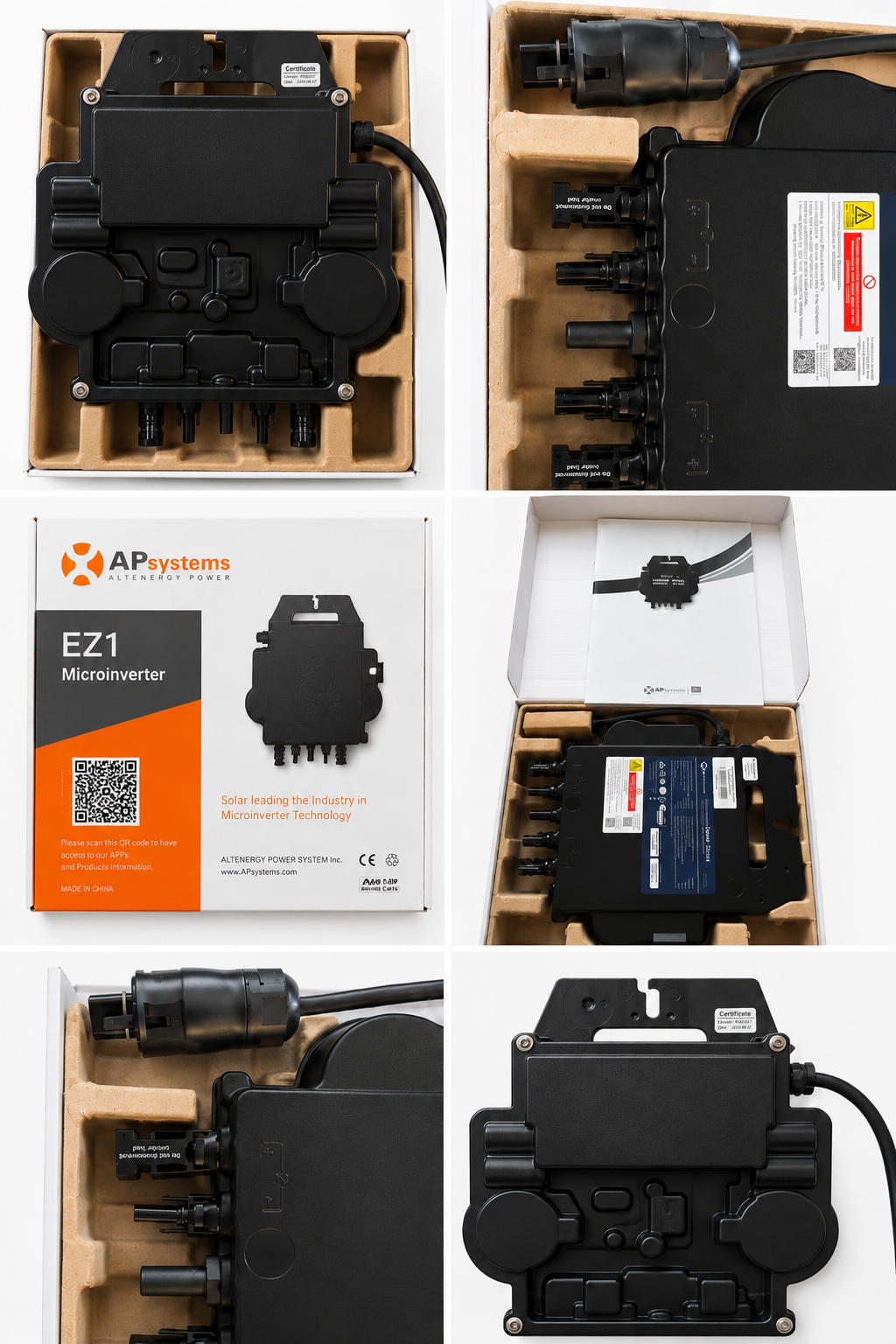
APsystems EZ1 microinverter box, packaging and unit photos
APsystems EZ1 microinverter unit and packaging. I have one of these units and will be updating this page after real-world testing.

Important UK note: this page is not saying the APsystems EZ1 is currently a finished UK plug-and-play consumer product that can simply be plugged into any socket without further checks.

APsystems clearly targets the EZ1 at balcony and DIY solar markets, and some APsystems material refers to socket-style connection in those markets. That does not remove the need to consider UK wiring rules, DNO notification, circuit suitability, product instructions and the final UK plug-in solar regulatory position.

So the wording matters: the EZ1 could become very relevant for UK plug-in solar, but it still needs to be treated as grid-connected generation equipment, not as a normal appliance load.

My first impressions:

I bought an APsystems EZ1 because I wanted to see what the hardware actually looks and feels like rather than relying only on online product photos.

First impressions are positive. The unit feels compact and well put together, the casing looks properly sealed, the connector arrangement makes sense, and the whole product feels much more serious than the no-name microinverters that sometimes appear in cheap “plug and play solar” adverts.

I will be testing this unit over the next month or so and then updating this page with practical comments on setup, monitoring, heat, real-world generation and whether anything stands out after using it properly.

APsystems deserves a proper page because the EZ1 sits right in the middle of the plug-in solar conversation.

It is not a traditional large rooftop solar inverter. It is not a portable power station. It is not just a battery accessory. It is a compact grid-tied microinverter designed for small solar systems, with a clear focus on balcony solar and DIY-style setups.

That makes it very relevant for UK readers because the UK is currently watching the same market develop from the outside. Germany and other European countries already have a mature balcony solar sector. The UK does not yet have the same simple consumer route, but products like the EZ1 show what the market could look like if rules become clearer.

Simple version: the APsystems EZ1 is one of the most credible microinverters to watch for future UK plug-in solar because it is already built for the small balcony solar category.

What is the APsystems EZ1?

The APsystems EZ1 is a dual-input solar microinverter. It connects to one or two solar panels on the DC side and converts the solar energy into grid-synchronised AC output.

A normal string inverter usually sits away from the panels and works with a group of panels connected together. A microinverter sits much closer to the panels and handles conversion at a smaller scale.

For plug-in solar and balcony solar, that compact microinverter approach makes sense because the system is normally small: often one or two panels, one microinverter and a limited AC output.

APsystems describes the EZ1 series as a Wi-Fi version for DIY, with built-in Wi-Fi and Bluetooth, two input channels with independent MPPT, high input current for larger modules, IP67 protection and an integrated safety protection relay.

  • One microinverter can connect to two solar modules
  • Two independent MPPT inputs
  • Built-in Wi-Fi and Bluetooth
  • Dedicated app monitoring through APsystems EasyPower
  • IP67 environmental protection
  • Safety protection relay integrated
  • Designed for balcony and DIY-style solar systems

Why the EZ1 matters for the UK plug-in solar market

The UK plug-in solar market is still not a settled, simple retail market. That is why a lot of the current discussion feels confusing.

On one side, the concept is simple: a small solar system that helps reduce household electricity imports. On the other side, the electrical reality is more serious: a grid-tied inverter is generation equipment connected to a home installation.

Products like the APsystems EZ1 matter because they are built for the small-generation category rather than being adapted from larger rooftop solar products.

If the UK eventually allows more consumer-friendly plug-in solar systems, the winning products are unlikely to be random cheap inverters with poor documentation. They are more likely to be compact, certified, well-documented products from established inverter manufacturers.

My view:

The EZ1 feels like the type of product that could fit the UK market if the UK gets proper rules for small plug-in solar. It is compact, consumer-facing and designed around the balcony solar idea, but it still comes from a recognised microinverter manufacturer.

APsystems EZ1-M vs EZ1-H

One thing buyers need to watch is the exact EZ1 model. APsystems documentation includes different EZ1 variants, and the output rating is not always the same.

The two key names UK readers are likely to see are the EZ1-M and EZ1-H. The exact model matters because the AC output rating, regional configuration and product approval route may not be identical.

Model Typical role Output figure commonly seen in APsystems documentation Why UK buyers should care
APsystems EZ1-M Lower-output balcony solar / DIY microinverter variant Often shown around the 799VA class depending on region and datasheet This sits close to the European 800W balcony solar conversation, so it is highly relevant to plug-in solar discussions.
APsystems EZ1-H Higher-output EZ1 variant Often shown around the 960VA class depending on region and datasheet Higher output may be useful technically, but UK rules and output limits matter more than simply choosing the biggest number.

Do not buy on model name alone.

Always check the exact product label, datasheet, country setting, AC output, plug/cable supplied, installation manual and compliance paperwork for the unit being sold.

APsystems EZ1 specifications

The specification is where the EZ1 starts to look more serious than many cheap online microinverters.

The key numbers are the dual MPPT inputs, 20A input current per channel, 60V maximum input voltage, 28V to 45V peak MPPT voltage range and IP67 protection.

APsystems EZ1 specification sheet
APsystems EZ1 specification sheet image used on this page. Always check the latest official datasheet before buying or connecting equipment.
Specification EZ1 detail to check Why it matters for UK plug-in solar
PV inputs Two input channels Allows a two-panel setup without putting the panels in series.
MPPT Two independent MPPTs Each panel can be tracked separately, which is useful where one panel may be shaded or angled differently.
Peak MPPT voltage range 28V–45V Important when matching panels. The panel Vmp should sit sensibly inside the inverter operating range.
Operating voltage range 26V–60V Shows the DC voltage window where the inverter can operate.
Maximum input voltage 60V The panel open-circuit voltage must not exceed this, including cold-weather voltage rise.
Maximum input current 20A x 2 Useful because modern large panels can have higher current than older panels.
Protection rating IP67 Important for outdoor mounting, although cable routing and connectors still need proper care.
Connectivity Built-in Wi-Fi and Bluetooth Allows direct setup and monitoring without needing a separate gateway in many setups.
Cooling Natural convection No fan, but mounting position and ventilation still matter.
Compliance references APsystems datasheets reference standards including EN 50549 and G98/G99 These are important references for grid-connected generation equipment, but buyers should still check the exact paperwork for their unit.

Panel matching: why voltage and current matter

Panel matching is one of the areas where people often get caught out.

It is not enough to say “this is a 400W panel” or “this is a 460W panel”. A microinverter does not only care about watts. It also has voltage and current limits.

The main panel figures to check are:

  • Voc — open-circuit voltage
  • Vmp — voltage at maximum power
  • Isc — short-circuit current
  • Imp — current at maximum power
  • Temperature coefficient — because cold panels can produce a higher voltage

With the EZ1, the 60V maximum input voltage is the figure I would be especially careful with. A panel may sit under that voltage in normal conditions but still have a higher cold-weather Voc than expected.

The 20A input current per channel is helpful because many modern panels have moved up in current. That is one reason the EZ1 looks better suited to newer higher-power panels than some older low-current microinverter designs.

Plain English version:

Do not match panels to the EZ1 by wattage alone. Check Voc, Vmp, Isc and Imp against the exact datasheet for the EZ1 model and the panel.

Anti-islanding and why it matters

Anti-islanding is one of the most important safety topics with any grid-tied inverter.

In simple terms, a grid-tied inverter must stop exporting power if the grid supply disappears. If there is a power cut, the inverter should not continue energising the circuit as though the grid is still present.

That matters for household safety, network safety and anyone working on the electrical system.

APsystems documentation for the EZ1 refers to safety relay protection and grid standards including EN 50549 and G98/G99 references. Those references are important because they show this is not just a basic DC-to-AC gadget. It is intended to operate as grid-connected generation equipment.

Why this matters:

Anti-islanding is one of the key differences between a proper grid-tied microinverter and unsafe or unsuitable equipment. A plug-in solar system must not continue pushing power into a dead circuit during a power cut.

EN 50549, G98 and G99: what the references mean

UK readers will often see standards and acronyms thrown around without much explanation.

For the APsystems EZ1, the important point is that the datasheet references grid-connection standards rather than only quoting marketing claims.

EN 50549 is a European standard area connected with requirements for generating plants connected in parallel with distribution networks. In practical terms, it sits in the world of grid-connected generation behaviour, including protection and disconnection behaviour.

G98 and G99 are UK engineering recommendation routes used for connecting generation to the distribution network. G98 is the simpler route generally associated with small-scale generation that fits within the relevant limits. G99 is for larger or more complex generation arrangements.

For a small plug-in solar product, the important buyer question is not just “does the inverter mention G98?” The real questions are:

  • Is this exact model accepted for the intended UK connection method?
  • Does the supplier provide the correct UK documentation?
  • Is the system being connected within the correct DNO process?
  • Does the installation match the manufacturer’s instructions?
  • Is the final circuit suitable for generation as well as load?

Important:

A standards reference on a datasheet is important, but it is not the same as saying every seller, cable, plug, setup and installation method is automatically suitable for every UK home.

Can the APsystems EZ1 be plugged into a normal socket?

This is the question most UK buyers will search for, so it needs a careful answer.

APsystems material for the EZ1 is clearly aimed at balcony and DIY markets, and the user manual includes wording around plugging into a wall socket. That may reflect how these systems are used in some European markets where balcony solar has a more established consumer route.

For UK readers, that wording should not be treated as a blanket instruction to plug the unit into any normal UK socket without further checks.

A socket is not just a socket once generation is involved. The circuit design, protective device, RCD/RCBO type, loading, ring final arrangement, backfeed behaviour, DNO notification and manufacturer instructions all matter.

That is why I would treat the EZ1 as a serious microinverter to watch, but not as an excuse to ignore the UK electrical side.

My practical answer: the EZ1 may be designed for socket-style balcony solar markets, but UK buyers should still read the UK position on plugging solar into a normal socket before assuming anything.

Why a microinverter is different from a normal appliance

A normal appliance takes power from the circuit. A grid-tied microinverter can feed power into the circuit.

That change sounds small, but electrically it matters. Protective devices, conductor loading, fault behaviour, isolation, labelling and energy flow can all become more complicated when power can move in more than one direction.

This is why plug-in solar is often misunderstood. People see a plug and assume it behaves like a kettle, heater or phone charger. It does not. A microinverter is synchronising with the grid and exporting energy into the installation.

That does not mean small solar is automatically dangerous. It means the product, rules and installation method need to be right.

EZ1 and bidirectional current: why RCBOs matter

One of the big technical issues with plug-in solar is bidirectional current.

If a final circuit has both normal loads and a source of generation connected to it, current flow may not behave in the simple one-direction way many people imagine.

Modern UK discussions around protective devices increasingly focus on whether RCBOs and similar devices are suitable for bidirectional current and whether line/load orientation matters.

This is not a reason to panic. It is a reason to be careful.

If the UK plug-in solar market grows, I expect protective device suitability to become one of the biggest topics. It is already one of the reasons I keep saying plug-in solar needs proper standards and clear instructions, not just “plug it in and hope”.

For more detail on this, read the guide to RCBOs, bidirectional current and plug-in solar.

How the EZ1 compares with EcoFlow and Anker

APsystems is slightly different from consumer brands like EcoFlow and Anker.

EcoFlow and Anker are strong consumer energy brands. They focus heavily on complete ecosystems, batteries, apps and packaged consumer products.

APsystems feels more like a technical inverter manufacturer that has produced a consumer-facing balcony solar microinverter.

That difference matters. If a buyer wants a full battery ecosystem, EcoFlow or Anker may be the names they recognise first. If a buyer is looking at the inverter hardware behind small solar systems, APsystems becomes very important.

Brand / product Main strength Main UK question
APsystems EZ1 Compact dual-MPPT microinverter designed for balcony and DIY solar markets. How the exact model, cable and connection method fits UK rules and DNO requirements.
EcoFlow STREAM / PowerStream Consumer battery ecosystem, solar products, app control and packaged energy systems. How UK plug-in cables, open-end cables, batteries and final connection routes are handled.
Anker SOLIX Strong consumer brand with Solarbank-style storage and balcony solar presence in Europe. How aggressively Anker enters the UK market and how UK-specific approvals are handled.

Where the EZ1 could fit in a future UK kit

A future UK plug-in solar kit could end up looking quite simple from the customer’s point of view:

  • One or two solar panels
  • A compact microinverter such as the EZ1
  • Approved AC cable and connector arrangement
  • Clear installation instructions
  • Clear DNO notification process
  • Correct labelling and safety information
  • Optional monitoring app
  • Possibly a battery system, depending on future rules

The hard part is not making the product look simple. The hard part is making it genuinely safe, properly documented and suitable for ordinary UK homes.

That is why I think companies with proper inverter experience could have an advantage over brands selling vague “plug and play” kits with poor documentation.

What I will be testing on my EZ1

I do not want this page to be only a desk-researched product summary. I have the unit, and I want to build a more useful UK review after using it properly.

The areas I want to check include:

  • How easy the EZ1 is to set up
  • How reliable the Wi-Fi and Bluetooth connection feels
  • Whether the app gives useful real-world data
  • How warm the unit gets in normal use
  • How it behaves with modern higher-power panels
  • How clear the documentation is
  • Whether the connectors and cable arrangement feel robust
  • Whether anything feels unsuitable for UK use without further adaptation

Planned update:

Once I have run the EZ1 for a while, I will update this page with a more practical review rather than just first impressions. I especially want to see how stable the monitoring is and whether the hardware lives up to the spec sheet.

What UK buyers should check before buying an EZ1

If you are looking at the APsystems EZ1 for a UK project, I would not start with the price. I would start with the paperwork and connection method.

Before buying, check:

  • The exact model: EZ1-M, EZ1-H or another variant
  • The AC output rating
  • The country or grid profile supported
  • The latest official APsystems datasheet
  • The user manual for the exact model
  • Whether the seller supplies UK-relevant documentation
  • Whether the product is being sold for your intended use
  • Whether the AC cable is open-ended, socket-based or region-specific
  • Whether DNO notification is required
  • Whether your circuit and protective devices are suitable
  • Whether your panel voltage and current are within limits

Important warning:

Do not buy an EZ1 from a random seller assuming every version is automatically suitable for UK plug-in solar. The exact version, cable, paperwork, grid setting and instructions matter.

MC4 connectors and solar cable quality

The inverter is only one part of the system. The connectors and cables matter as well.

Cheap MC4-style connectors are one of the most overlooked risks in DIY solar. Poorly matched connectors, badly crimped pins, loose connections or low-quality plastic can create heat and long-term reliability problems.

With a small plug-in solar setup, people sometimes focus so much on the inverter that they ignore the DC side. That is a mistake.

For an outdoor solar setup, I would want proper solar cable, proper connectors, good strain relief, sensible routing, no crushed cables, no connectors lying in standing water and no improvised joints.

A good microinverter does not make a poor cable installation safe. Connectors, cable routing, weather protection and strain relief still matter.

Should UK buyers buy the APsystems EZ1 now?

I think the EZ1 is one of the most interesting microinverters for UK buyers to understand, but I would still be cautious about buying it casually.

If you are technically confident and you are buying it for research, testing or a properly considered small solar setup, it is clearly worth looking at.

If you are an ordinary homeowner expecting a simple UK-approved plug-and-play kit that you can connect without reading anything else, I would slow down and understand the wider position first.

The product itself looks credible. The UK situation is the complicated bit.

My verdict:

The APsystems EZ1 is one of the strongest microinverters to watch for the UK plug-in solar market. It looks much more credible than cheap unknown inverters, has proper balcony-solar design intent, and includes the sort of features small solar systems need. But UK buyers still need to treat it as generation equipment and check the exact model, documentation, connection method and rules before using it.

EcoFlow affiliate link:

If you are also comparing consumer battery and solar ecosystems, you can view EcoFlow UK products here.

This is an affiliate link, which means PluginSolarHub may earn a commission if you buy through it, at no extra cost to you.

I still recommend reading the technical guidance first. A good product is only useful if the connection method, cable, instructions and UK suitability are properly understood.

Official APsystems sources checked

This page is based on the APsystems EZ1 product information, APsystems EMEA EZ1 documentation and the EZ1 user manual/specification details available at the time of writing.

Product specifications and regional approvals can change, so always check the latest official APsystems documents before buying or connecting equipment.

How the APsystems EZ1 fits into the wider UK plug-in solar market

The APsystems EZ1 is important because it shows the type of hardware that could sit behind a more mature UK plug-in solar market.

It is compact enough for small systems, powerful enough for modern panels, and designed around the balcony solar category that is already common in parts of Europe.

The UK still needs clearer rules, clearer consumer guidance and a safer product route. But if that happens, I expect products like the EZ1 to appear much more often in UK discussions.

If you are still learning about the wider topic, I recommend reading the guides on whether plug-in solar is legal in the UK, G98 and DNO registration, plugging solar into a normal socket, why many plug-in solar systems are limited to 800W, and microinverter safety.

The bottom line

The APsystems EZ1 is one of the most important microinverters to understand if you are following plug-in solar in the UK.

It is not just interesting because of the wattage. It is interesting because it combines a small balcony-solar format with dual MPPT inputs, modern panel compatibility, app monitoring and proper grid-connected inverter documentation.

That combination makes it far more relevant than many of the low-quality “plug and play” products that appear online.

But the UK question is still not solved by buying a good inverter. The system still needs the right connection method, correct circuit protection, suitable cables, DNO compliance and clear manufacturer instructions.

My final view:

The APsystems EZ1 looks like a serious candidate for the future UK plug-in solar conversation. I would not describe it as a free pass to plug solar into any UK socket, but I would absolutely put it on the shortlist of microinverters UK buyers should understand.

Common questions

What is the APsystems EZ1?

The APsystems EZ1 is a compact dual-input microinverter designed for small solar, balcony solar and DIY-style solar systems. It connects to one or two solar panels and converts DC solar energy into grid-synchronised AC output.

Is the APsystems EZ1 a plug-in solar inverter?

It is clearly aimed at the balcony solar and DIY solar category, which is closely linked to plug-in solar in Europe. UK readers should still check the exact model, cable, instructions and UK connection rules before treating it as a simple plug-in product.

Does the APsystems EZ1 have anti-islanding?

APsystems documentation references grid-connected safety features including an integrated safety protection relay and standards such as EN 50549 and G98/G99. Anti-islanding is the safety function that disconnects the inverter if the grid supply is lost.

Can the APsystems EZ1 be plugged into a UK socket?

APsystems material refers to socket-style use in the balcony solar market, but UK buyers should not assume this automatically means it can be plugged into any UK socket. Circuit suitability, DNO requirements, protective devices, manufacturer instructions and UK rules all matter.

What panels work with the APsystems EZ1?

Panel matching should be checked against the exact EZ1 datasheet. Important figures include maximum input voltage, peak MPPT voltage range, operating voltage range and input current per channel.

Is the APsystems EZ1 better than cheap online microinverters?

The EZ1 appears far more credible than many cheap unknown inverters because it comes from an established microinverter manufacturer and has proper product documentation. Buyers should still check the exact unit, seller, paperwork and intended use.

Related guides on PluginSolarHub

Back to home Compare plug-in solar kits Read the brand guide Contact

This page is intended as practical guidance, desk research and first impressions, not legal advice, electrical design advice, installation instructions or a substitute for current standards, manufacturer instructions, DNO requirements or site-specific electrical advice. Product specifications, cable types, warranties, approvals, UK availability and regulatory positions can change. Always check the latest official documentation before buying or connecting electrical generation equipment.